

CEO essay
Trillions of Dollars in Concrete Depend on One Chinese GitHub Repository
NVIDIA and the broader American AI industry are building the largest computing infrastructure project in history.
- Author
- Eitan Lasker
- Published
- Updated
- Publisher
- TickerVoice by Eitan Lasker
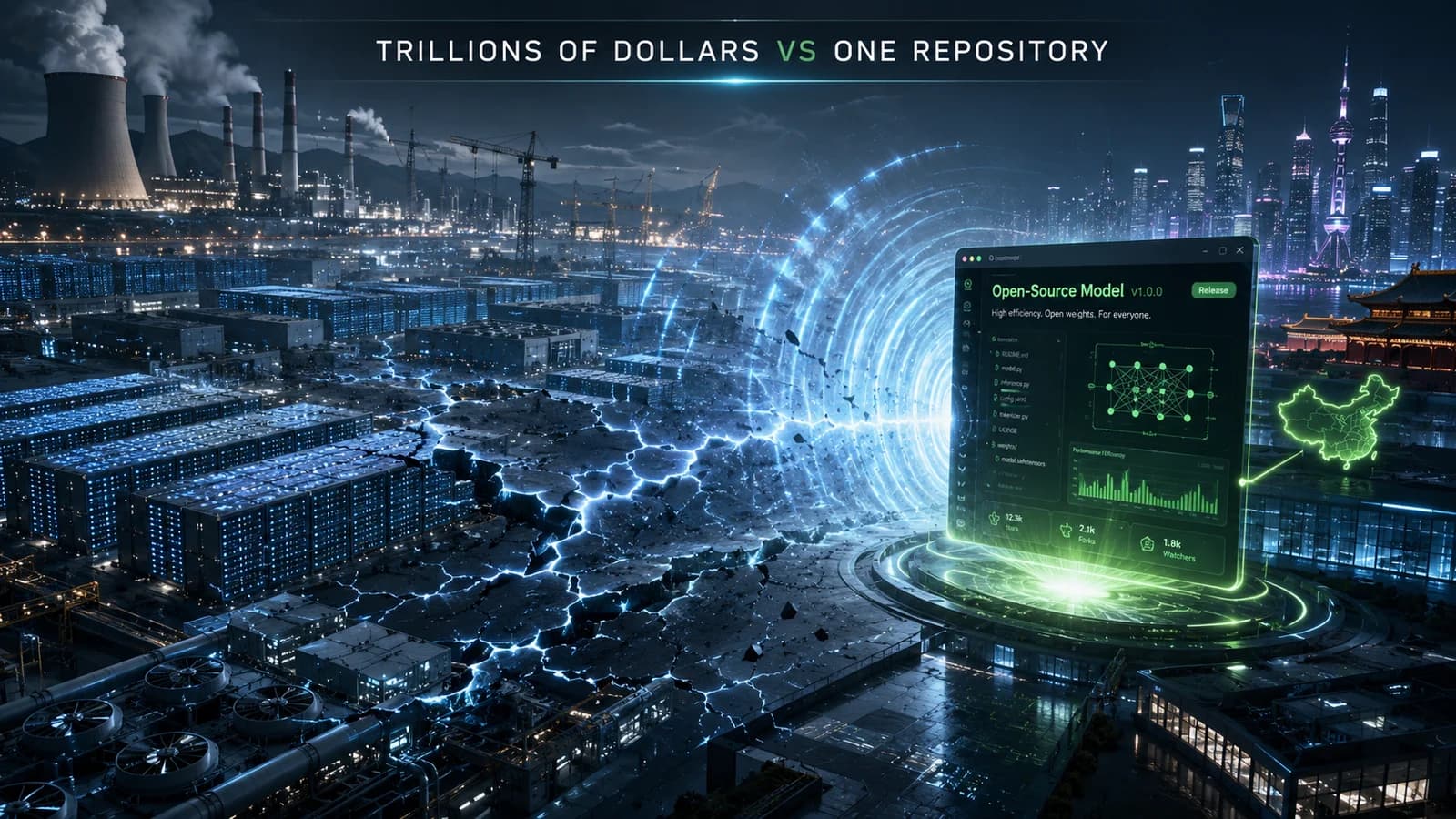
NVIDIA and the broader American AI industry are building the largest computing infrastructure project in history.
Data centers, power plants, electrical grids, cooling systems, memory production, semiconductor factories, and enormous cloud clusters are being constructed around expected future demand for artificial intelligence.
The entire economic structure rests on one assumption:
**As AI becomes more capable, it will require increasingly large amounts of expensive computing power.**
But what happens if that assumption is wrong?
NVIDIA’s greatest threat may not be AMD, Google’s TPUs, or even a Chinese competitor producing similar GPUs.
The real disruption could come from a Chinese model or architecture capable of delivering comparable results with five or ten times less compute.
DeepSeek has already demonstrated the direction of attack: you do not necessarily need more chips if you can use the existing ones far more efficiently.
The next project could go further:
* approach the quality of the best closed models; * dramatically reduce training and inference costs; * release open weights; * allow unrestricted commercial deployment.
Such a project would not stop the growth of AI.
It would probably accelerate it.
But it could destroy the economics of infrastructure built for an era of expensive intelligence.
## AI Can Win While Infrastructure Investors Lose
This distinction matters.
Growth in AI usage does not guarantee rising profits for data-center owners.
If model efficiency improves tenfold while demand grows only fivefold, the world will need half as much computing infrastructure as investors originally expected.
Even if total compute consumption continues to increase, the cost of each task, cloud margins, and demand for the most expensive GPUs could fall far below current projections.
The technology may succeed.
Users may benefit.
Infrastructure owners may still be left holding expensive assets and enormous debts.
## The Speeds Are Fundamentally Incompatible
A data center takes years to build.
Power infrastructure takes even longer.
Loans, bonds, and energy contracts are structured over decades.
But a new model architecture can be developed within months and published in a single morning.
On Friday, a bank finances a new AI cluster based on an assumed future price of compute.
On Monday, a small team releases open-source code that reduces that price several times over.
The buildings remain.
The GPUs continue running.
Electricity continues flowing.
Interest payments continue accumulating.
Only the expected return disappears.
## There Are Almost No Safety Mechanisms
There is no serious stress test for a scenario in which inference costs fall by 90%.
There is no mechanism to pause data-center construction after a radically more efficient architecture appears.
There is no reliable way to estimate how much physical infrastructure AI will actually require five years from now.
We are financing twenty-year assets based on a technology whose economics can change within a single quarter.
China does not need to create the world’s most intelligent AI system.
It only needs to create one that is good enough, dramatically cheaper, open, and easy to deploy independently.
America could build the most expensive AI infrastructure system in history.
A single Chinese project could then make a significant part of it not technically useless, but **economically redundant**.
The risk to NVIDIA is not that artificial intelligence stops advancing.
The risk is that intelligence becomes cheap before the infrastructure built for expensive intelligence has paid for itself.
**Trillions of dollars are being invested in concrete, copper, electricity, and silicon. Yet the value of the entire structure may depend on one new GitHub repository.**
And this system has no emergency stop button.
This article is a strategic market-structure note. It is not investment advice.
Registered sources
No comments yet.