

CEO essay
Why Arm Could Become One of the Near-Term Winners in the AI Compute Race
For the last two years, investors have mostly looked at AI infrastructure through one dominant lens: GPU acceleration. Nvidia became the obvious winner because training large AI models required massive parallel compute.
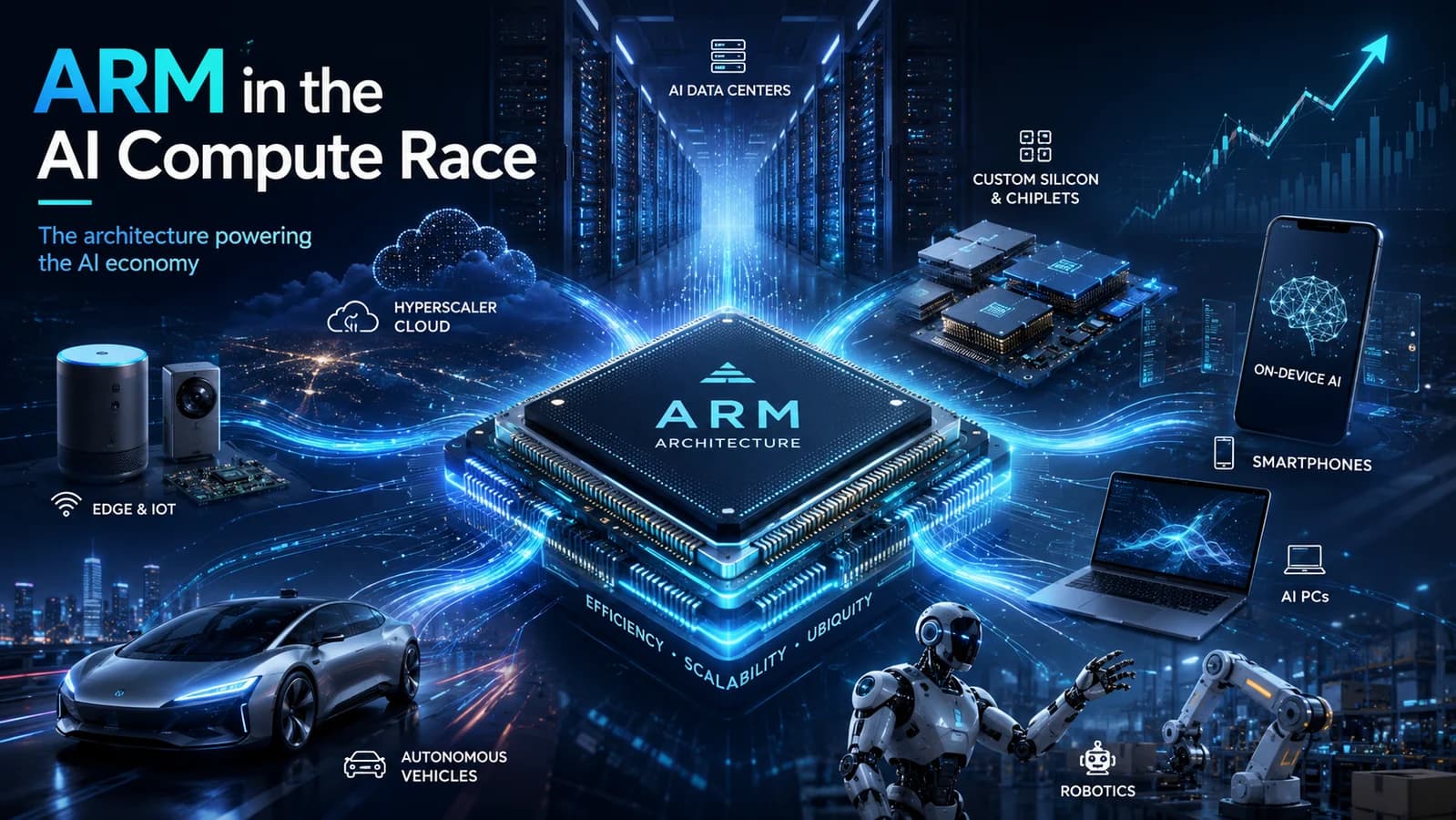
Main idea
The AI trade is no longer only about GPUs.
That is the key point.
For the last two years, investors have mostly looked at AI infrastructure through one dominant lens: GPU acceleration. Nvidia became the obvious winner because training large AI models required massive parallel compute.
But the next phase of the AI buildout may be broader.
AI is moving into data centers, smartphones, PCs, cars, robots, industrial devices, and edge infrastructure. That requires not only more compute, but more efficient compute. And this is where Arm becomes strategically important.
Arm is not just a chip company. It is an architecture platform.
That difference matters.
A traditional chipmaker needs to win specific product cycles. Arm can benefit from many different winners at once: hyperscalers building custom CPUs, Nvidia using Arm-based systems, smartphone makers upgrading to AI-first devices, automotive platforms requiring efficient compute, and edge AI devices needing better performance per watt.
In other words, Arm is becoming a toll road for the AI compute economy.
The demand side is already visible. Arm has shown strong growth in licensing and royalty revenue, while data-center exposure is becoming increasingly important. The company is also pushing deeper into higher-value compute platforms through Armv9 and Compute Subsystems, which can help partners reduce chip design complexity and bring products to market faster.
That is a critical point: in AI infrastructure, speed matters.
The winners will not only be the companies with the best chips. They will also be the companies that help the ecosystem design, validate, and deploy new silicon faster. Arm is positioning itself exactly there.
The investment thesis is simple:
Arm sits at the intersection of three major trends:
1. AI data-center expansion 2. Custom silicon adoption by hyperscalers 3. On-device AI across phones, PCs, cars, and edge devices
This gives Arm several growth engines instead of one narrow bet.
The risk is valuation. Arm is already priced like a premium AI infrastructure asset, so this is not a “cheap hidden gem” story. The market clearly understands part of the opportunity.
But strategically, the company’s position is getting stronger.
If AI compute keeps expanding beyond GPUs into CPUs, custom chips, edge devices, and low-power inference, Arm may be one of the clearest beneficiaries.
The market may still think of Arm as the company behind mobile chips.
The better framing may be this:
Arm is becoming one of the foundational architectures underneath the AI economy.
This article is a strategic market-structure note. It is not investment advice.
Registered sources
No comments yet.